unctad.org
UNCTAD Technology and Innovation Report 2025
A UNCTAD report on artificial intelligence, technological change, and development.
https://unctad.org/publication/technology-and-innovation-report-2025About This Resource
A UNCTAD report on artificial intelligence, technological change, and development. It examines the distribution of AI capabilities and the policy choices involved in broadening access to its benefits.
Saved Notes
Original notes saved with this link. They may describe an earlier version.
Technology and Innovation Report 2025
✨
AI-generated summary
The summary below is mostly AI-generated, except for images which are from the original material.
A write-up might be added in this page sometime soon.
- The frontier technologies market, including AI, is projected to grow sixfold to $16.4 trillion by 2033, with AI leading the market.
- Market power, R&D, and knowledge creation are highly concentrated in a few tech giants (Apple, Nvidia, Microsoft, Alphabet, Amazon) and developed countries (USA, China), creating an "AI divide" that risks widening global inequalities.
- AI has transformative potential for productivity and human labor but also presents risks of job displacement, labor dynamics shifts, and increased inequality without proper policies.
- Developing countries face challenges in AI adoption, such as lack of infrastructure, data, and skills, but can strategize for inclusive growth through targeted policies and partnerships.
- The UNCTAD frontier technologies readiness index highlights significant gaps in AI readiness between developed and developing nations but also showcases strong performances by countries like Singapore, China, and India.
- National policies for AI require a whole-of-government approach, addressing key leverage points: infrastructure, data ecosystems, and workforce skills.
- Global AI governance is fragmented and dominated by developed countries and tech giants, risking neglect of global needs and equity.
- Collaboration is essential, with proposals for shared Digital Public Infrastructure, Open Innovation models, and South-South cooperation to ensure AI aligns with social objectives and shared prosperity.
- AI policies must address risks like bias, privacy, security, and environmental impact while promoting inclusion, equity, and human-centric development.
Chapter I: AI at the technology frontier
Overview
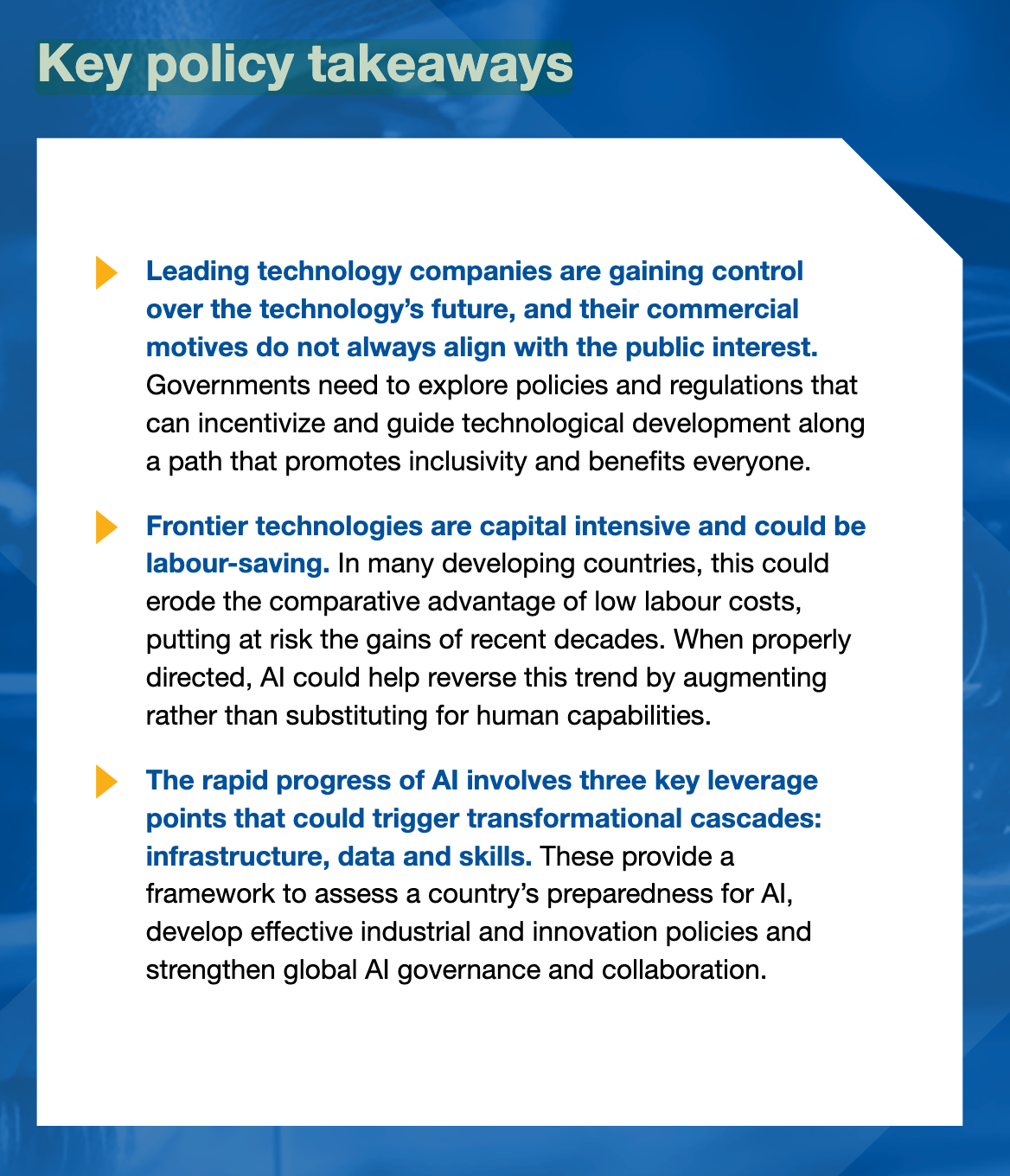
This chapter sets the stage by highlighting the rapid expansion and immense market potential of frontier technologies, particularly Artificial Intelligence, projected to reach $16.4 trillion by 2033. It outlines the significant concentration of market power, R&D investment, and knowledge creation within a few tech giants and developed countries, primarily the United States and China. The chapter emphasizes the resulting AI divide, which risks widening inequalities and hindering developing countries, while positioning AI as a crucial general-purpose technology requiring careful navigation for sustainable development.
Key Points
- Frontier technologies market is expanding rapidly, projected to grow sixfold to $16.4 trillion by 2033, with AI expected to be the largest share.
- Market power, R&D, and knowledge creation are highly concentrated in tech giants (like Apple, Nvidia, Microsoft, Alphabet, Amazon) and a few developed countries (USA, China).
- A significant "AI divide" exists between developed and developing countries concerning infrastructure, investment, and knowledge, risking increased global inequalities.
- AI acts as a general-purpose technology, synergising with and augmenting other frontier technologies (IoT, Big Data, Robotics, etc.).
- AI development is driven by three key leverage points: infrastructure (computing power, data centers), data (volume, quality), and skills (talent).
- The development and deployment of AI present both significant opportunities for growth and SDGs, but also risks (bias, privacy, security, environmental impact) that require careful policy guidance.
Chapter II: Leveraging AI for productivity and workers’ empowerment
Overview
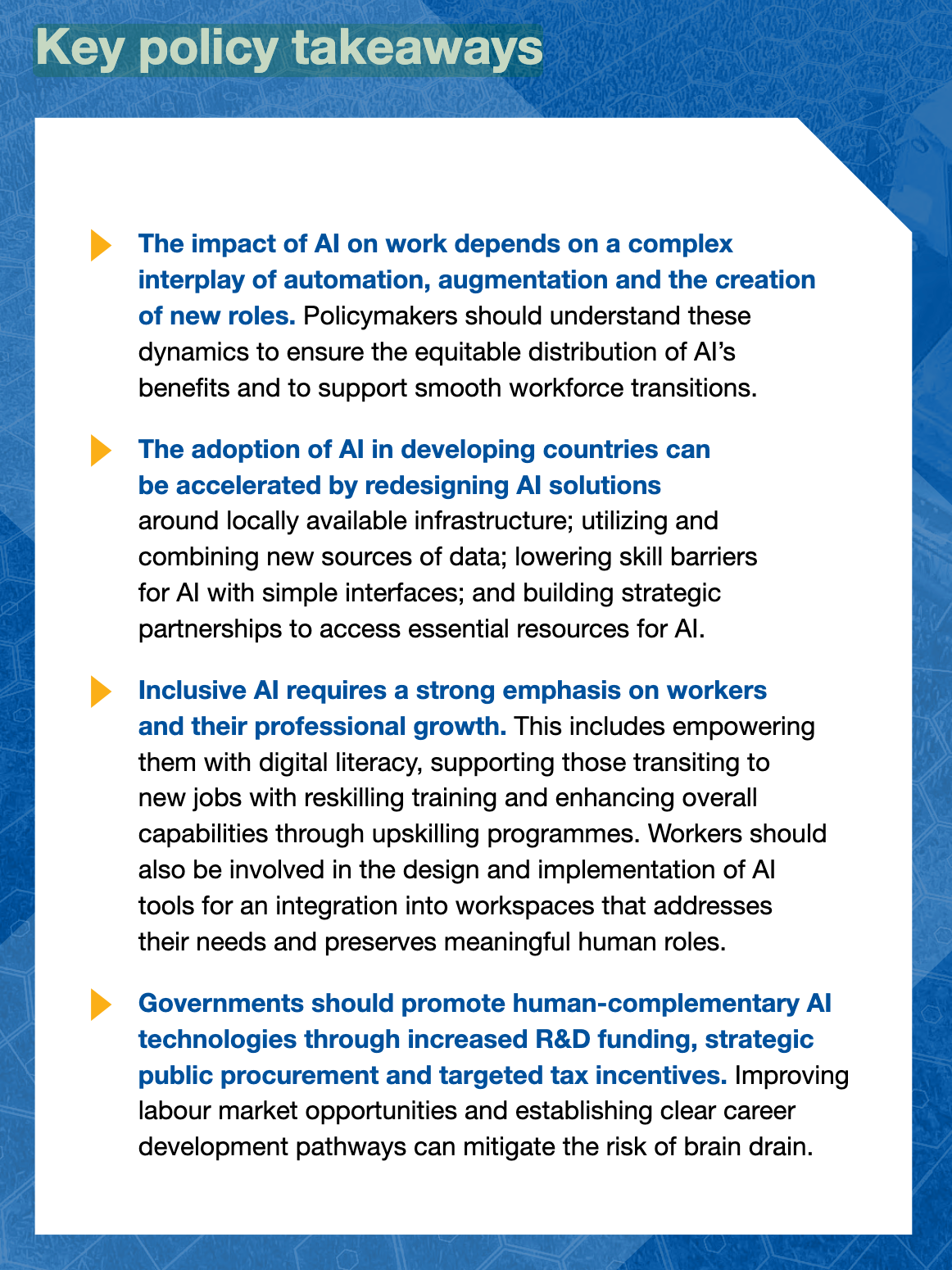
- This chapter explores the transformative impact of AI on production processes, productivity, and the workforce, noting its ability to perform cognitive tasks impacting a wide range of activities. It analyzes the dual potential of AI to increase productivity and augment human capabilities, but also to displace jobs, reshape labor dynamics, and shift value towards capital. The chapter uses case studies from developing countries (agriculture, manufacturing, healthcare) to illustrate how AI adoption challenges can be overcome and stresses the need for worker-centric policies to ensure inclusive benefits and empowerment.
Key Points
- AI can transform production by performing cognitive tasks, automating processes, and augmenting human labor, potentially affecting 40% of global employment.
- AI impacts productivity and the workforce through four channels: substituting human labor, complementing human labor, deepening automation, and creating new jobs.
- Early evidence suggests AI, particularly GenAI, can significantly increase productivity in specific tasks and firms, but the overall long-term impact and distribution of benefits are uncertain.
- Developing countries face chal, data, skills) but can leverage AI through adapted -friendly interfaces, and strategic pa Easy, Partner).Takeaways: Adapt, Utilize, Make
- AI adoption risks exacerbating inequalities (skills bias, gender divide), highlighting the need for policies focused on reskillin., ups desig), and promoting human-complementary AI through public policy. (e.g., data annotation
Chapter III: Preparing to seize AI opportunities
Overview
This chapter assesses the preparedness of countries, especially developing ones, to capitali reshaped by frontier technologies. It introduces the UNCTAD frontier technologies readiness index, which shows developed nations leading but highlights notable performance by some developing countries like Singapore, China, and India. The chapter emphasizes the critical role of infrastructure, data, and skills as key leverage points for AI adoption and development, advocating for strategic positioning based on assessing these capacities.
Key Points
- The UNCTAD frontier technologies readiness index measures national preparedness across ICT, skill, R&D, industry, and finance.
- Developed countries dominate the index rankings, but several developing countries (e.g., Singapore, China, India, Brazil, Philippines) show strong performance or outperform relative to their income levels.
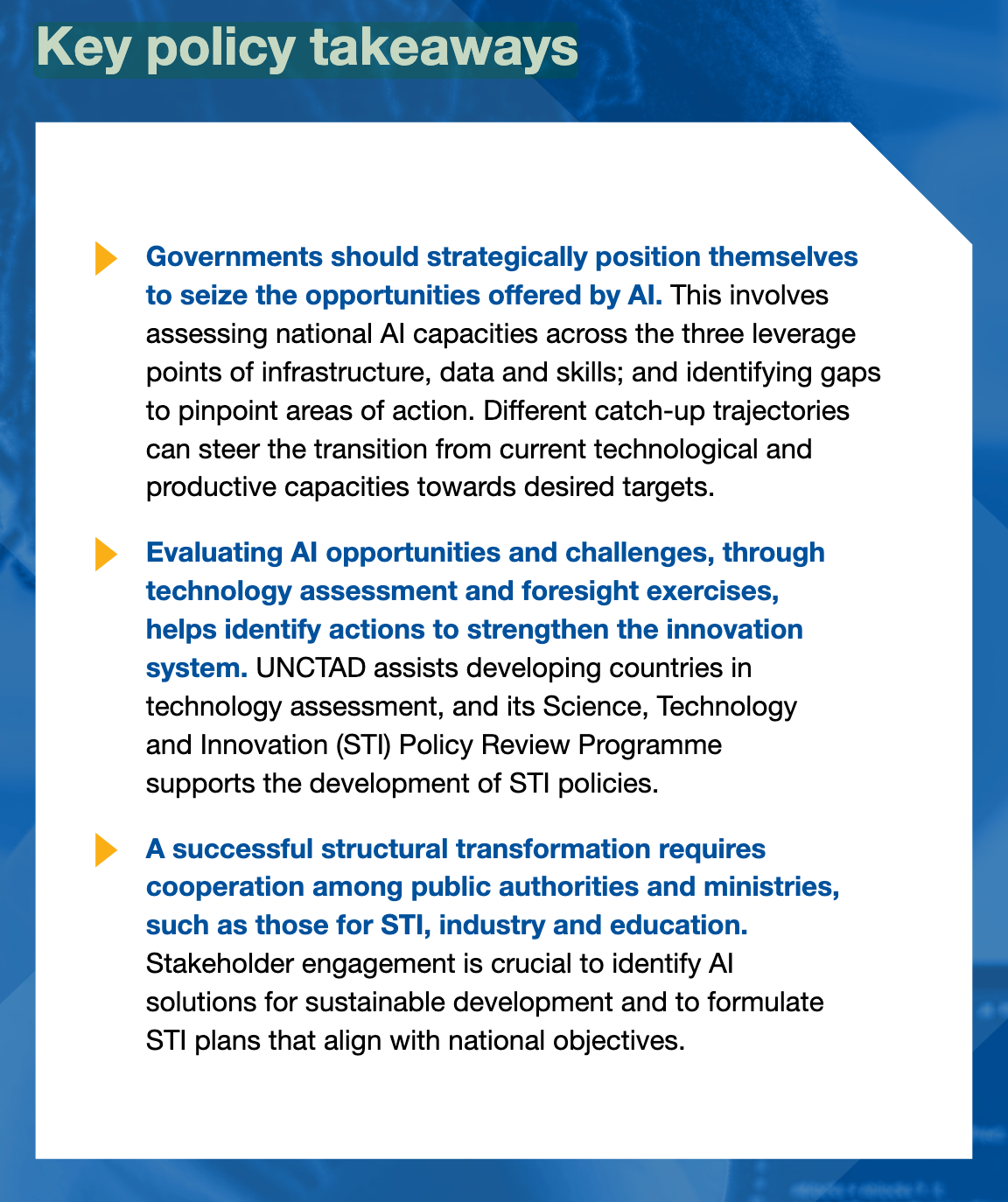
- AI adoption and development critically depend on three leverage points: infrastructure (connectivity, computing power), data (quantity, quality, accessibility), and skills (basic digital literacy, advanced AI skills, complementary cognitive skills).
- Significant gaps exist between developed, developing, and least developed countries across these leverage points, particularly in R&D, skills, and industry subindices.
- Assessing national AI readiness across infrastructure, data, and skills is essential for strategic positioning, identifying strengths/weaknesses, and defining catch-up trajectories.
- Strategic positioning requires cooperation across public bodies (STI, industry, education) and stakeholder engagement to align AI solutions with national objectives.
Chapter IV: Designing national policies for AI
Overview
This chapter focuses on the necessity for nations to design and implement specific AI policies integrated within broader industrial and innovation strategies to enhance competitiveness in a knowledge-intensive global economy. It notes the revival of industrial policy adapted for AI and frontier technologies, currently led by developed nations, and urges developing countries to create tailored strategies for both adopting and developing AI. The chapter emphasizes a whole-of-government approach, highlighting good practices and the need for policies addressing the key leverage points: infrastructure, data, and skills.
Key Points
- National competitiveness increasingly requires proactive industrial and STI policies that incorporate AI development and adoption.
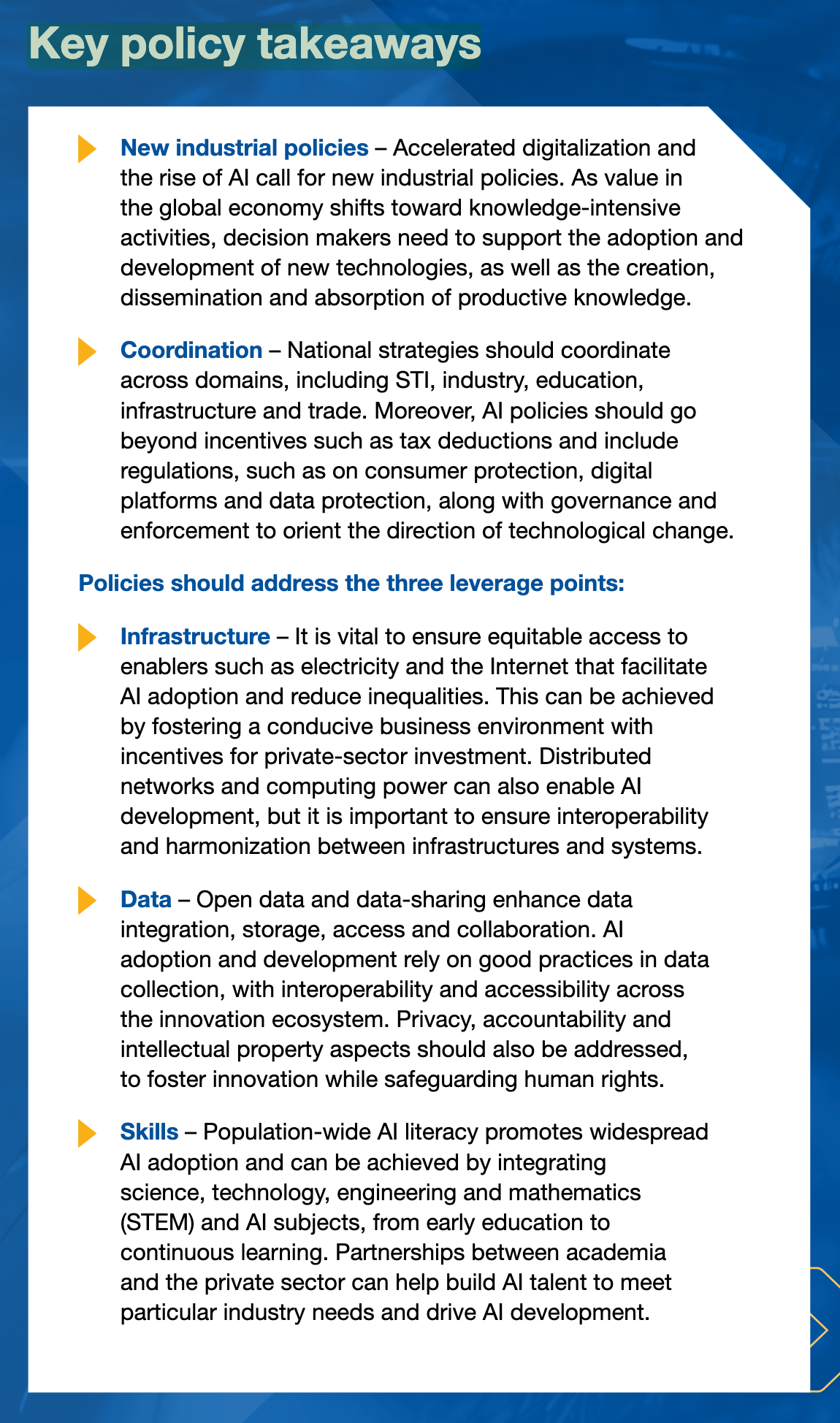
- Industrial policy is reviving, shifting focus from traditional trade protection towards direct support for productive sectors, STI, and knowledge-intensive services.
- Most AI policies originate from developed countries; developing countries need to quickly design policies aligned with national goals to avoid being left behind.
- AI policies should strategically target both adoption (uptake and diffusion) and development (capacity generation).
- Effective AI policy requires a whole-of-government approach, coordinating across STI, industry, education, infrastructure, and trade, and including regulation alongside incentives.
- Policies must address bottlenecks and build capabilities in the three key leverage points: strengthening infrastructure, building responsible data ecosystems (including open data), and reskilling/upskilling the workforce for AI.
Chapter V: Global collaboration for inclusive and equitable AI
Overview
This chapter addresses the fragmentation and inequity in current international AI governance, which is largely dominated by developed countries and a few tech giants, potentially failing global needs. It argues for urgent global collaboration and a multi-stakeholder approach to establish international guidance that promotes AI as a public good, ensuring it is accessible, beneficial, inclusive, and equitable worldwide. The chapter proposes concrete mechanisms like shared digital public infrastructure, open innovation, global hubs, and South-South cooperation to steer AI development towards shared prosperity and human values.
Key Points
- Current international AI governance is fragmented, lacks broad representation (especially from the Global South), and is driven largely by G7 members.
- The dominance of multinational tech giants in AI development creates risks of prioritizing profit over public interest and potential vulnerabilities for countries.
- Aligning AI with social objectives requires a multi-stakeholder approach involving governments, industry, academia, and civil society, including consumer views.
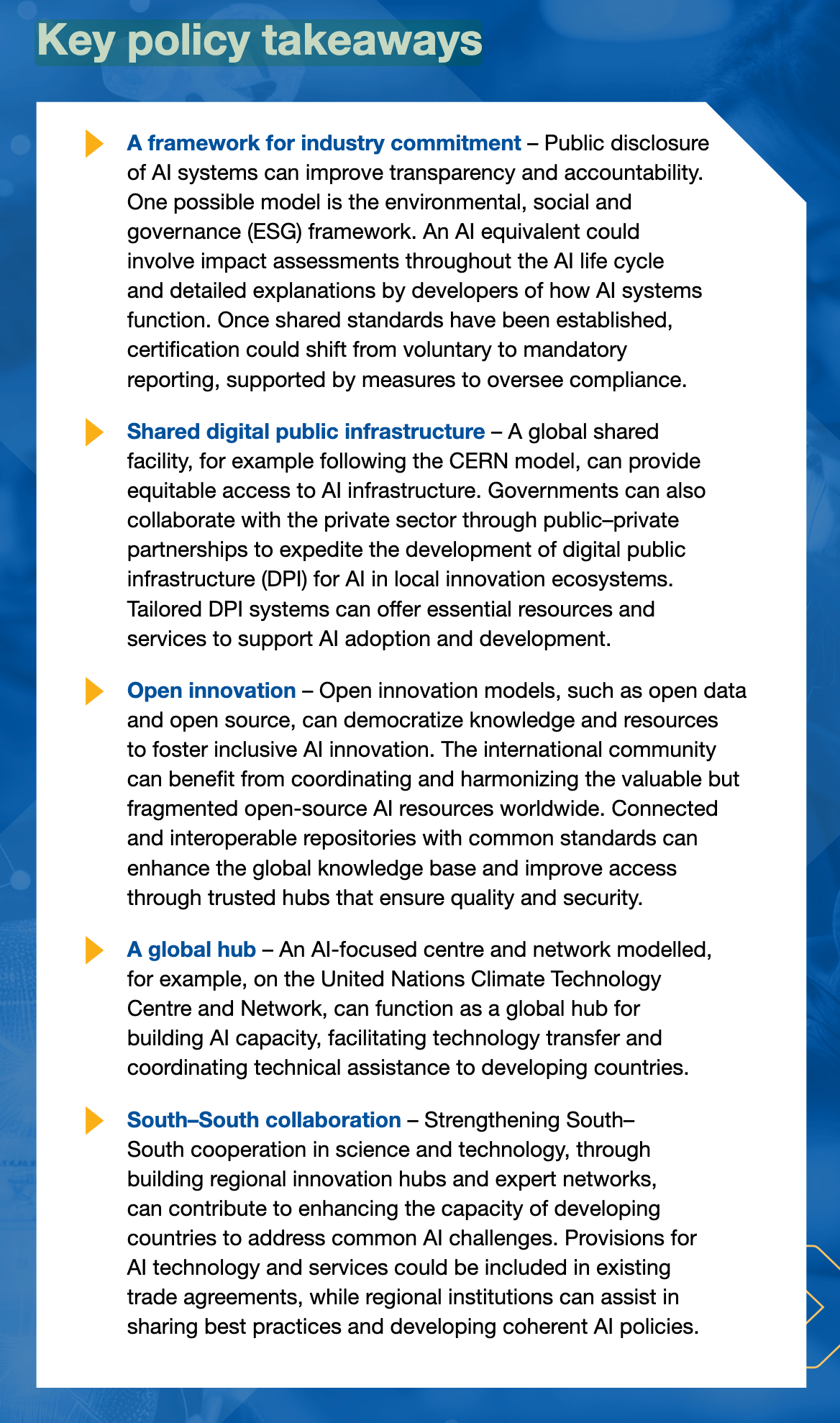
- Ensuring accountability requires frameworks for public disclosure, impact assessment, and potential certification, possibly modelled on ESG principles.
- International cooperation is essential across infrastructure, data, and skills. Key proposals include:
- Developing shared Digital Public Infrastructure (DPI) for AI (e.g., a CERN-like model).
- Promoting AI through Open Innovation (open data, open source, harmonized repositories).
- Strengthening capacity-building and research collaboration (e.g., global hubs, South-South cooperation).
- Guiding AI towards shared prosperity requires putting humans at the centre, ensuring AI complements workers, and promoting inclusion and equity through global action.